
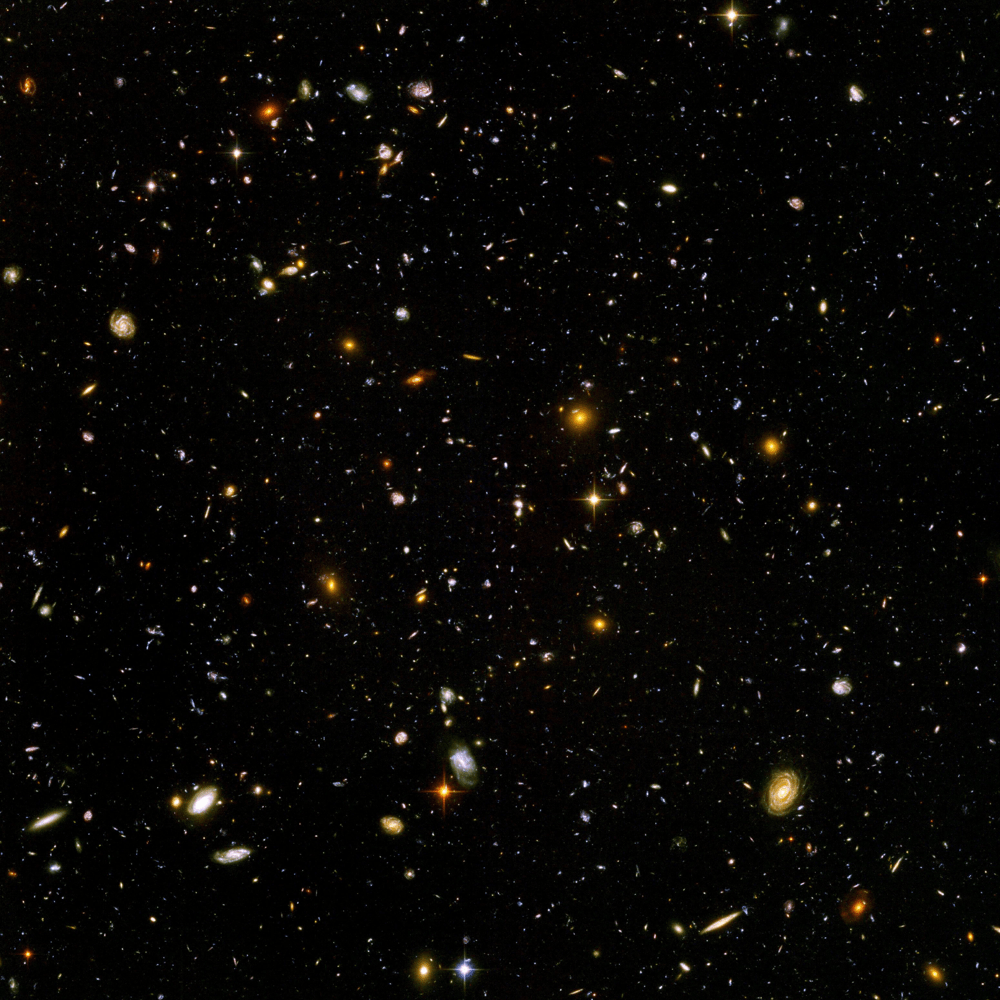
Epigraph:
الَّذِي خَلَقَ سَبْعَ سَمَاوَاتٍ طِبَاقًا ۖ مَّا تَرَىٰ فِي خَلْقِ الرَّحْمَٰنِ مِن تَفَاوُتٍ ۖ فَارْجِعِ الْبَصَرَ هَلْ تَرَىٰ مِن فُطُورٍ
ثُمَّ ارْجِعِ الْبَصَرَ كَرَّتَيْنِ يَنقَلِبْ إِلَيْكَ الْبَصَرُ خَاسِئًا وَهُوَ حَسِيرٌ
He is the Mighty, the Forgiving; Who created the seven heavens, one above the other. You will not see any flaw in what the Lord of Mercy creates. Look again! Can you see any flaws? Look again! And again! Your sight will turn back to you, weak and defeated. (Al Quran 67:3-4)
Written and collected by Zia H Shah MD, Chief Editor of the Muslim Times
Introduction
The extraordinary precision of our universe’s physical laws has long stirred debate about a possible cosmic Designer. One striking example is the cosmological constant – a parameter in cosmology whose value appears “just right” for life. This essay explores what the cosmological constant is, why its value must be extraordinarily precise for the universe as we know it to exist, and how this extreme fine-tuning bolsters an argument for the existence of God. We will draw on insights from physicists and cosmologists to show that the cosmological constant’s uncanny calibration is most plausibly explained not by chance, but by the intent of an intelligent Designer.
The Cosmological Constant in Cosmology
In cosmology, the cosmological constant (denoted Λ) represents the energy density of empty space – often called vacuum energy or dark energy innovationnewsnetwork.com en.wikipedia.org. Originally introduced by Albert Einstein in his field equations of general relativity, Λ was later reinterpreted to account for the mysterious repulsive force driving the accelerated expansion of the universe en.wikipedia.org. Observations since the 1990s indicate that roughly 68% of the universe’s energy content is this dark energy. In other words, the cosmological constant today dominates the cosmic energy budget, making it crucial for the structure and fate of the universe. If Λ were significantly different, the balance between expansion and gravitational attraction would be upset – with dramatic consequences for the formation of galaxies, stars, planets, and any life that might depend on them.
Fine-Tuning and Improbability of Λ
What makes the cosmological constant so remarkable is the extreme precision of its value. Theoretical calculations of vacuum energy deviate from the observed value of Λ by an astonishing 120 orders of magnitude en.wikipedia.org. In effect, something must have “canceled out” an enormous vacuum energy to yield the tiny net cosmological constant we measure. Physicists widely acknowledge this as a serious puzzle – often dubbed the cosmological constant problem – and “the worst theoretical prediction in the history of physics” en.wikipedia.org. From a life-permitting perspective, Λ had to be set to an exceedingly narrow range. Estimates suggest that the cosmological constant must be fine-tuned to within one part in 10^120 to allow a universe that develops galaxies and life philosophersforchange.org. A value even slightly larger (in absolute terms) would cause space to expand so rapidly that matter could never clump into stars and galaxies; a slightly smaller or negative value could make the universe recollapse before life could arise.
This degree of fine-tuning is almost inconceivable. To appreciate how delicate this is, Leonard Susskind observes that we live “on the knife edge of existence” with respect to dark energy – if the cosmological constant were much bigger, “we wouldn’t be here” at all pbs.org. The odds of such a tiny, life-enabling cosmological constant emerging by blind chance are infinitesimal. As astrophysicist Freeman Dyson famously wrote, “The more I examine the universe, and the details of its architecture, the more evidence I find that the Universe in some sense must have known we were coming.” biologos.org In other words, the universe’s fundamental parameters (like Λ) seem almost miraculously calibrated to permit life. Even renowned British astronomer Sir Fred Hoyle – an avowed atheist – admitted that “a common sense interpretation of the facts suggests that a super-intellect has monkeyed with physics.” biologos.org Such statements underscore that the fine-tuning of Λ is not a speculative theological assertion, but an empirical observation that scientists (theist and atheist alike) find deeply perplexing.
Interpretations and Theistic Implications
How do we explain an improbability as staggering as a cosmological constant tuned to 1 in 10^120? Broadly, scientists and philosophers have proposed two types of explanations. One is chance – often fleshed out via the multiverse hypothesis. If our universe is but one of a vast (perhaps infinite) ensemble of universes with varying physical constants, then it is less surprising that we find ourselves in one of the few universes where the dice happened to land in a life-permitting way. The other explanation is design – the idea that the constants were deliberately set by an intelligent cause so that life (and observers like us) could emerge. Even those personally disinclined to theism recognize these as the main options. Astrophysicist Sandra Faber candidly stated that “one is that there is a God and that God made it that way” as an explanation for the cosmos’s fine-tuned parameters pbs.org. As an atheist, Faber herself prefers the multiverse conjecture, calling it “the only other approach that makes any sense” apart from divine creation pbs.org. Her frank assessment highlights that, absent a multiverse, the design hypothesis naturally arises to fill the explanatory gap.
Notably, several leading scientists find the multiverse explanation to be speculative at best. Nobel Prize-winning physicist Charles Townes pointed out that positing “an enormous number of universes” with different settings is “a pretty fantastic postulate” – essentially an unfalsifiable assumption made to avoid the alternative of cosmic design
newsarchive.berkeley.edu. Townes argued that “the other possibility is that ours was planned, and that’s why it has come out so specially” newsarchive.berkeley.edu. In his view, the incredible specificity of physical laws is more credibly explained by intentional planning than by a random draw from imaginary trillions of universes. This perspective aligns with the instincts of many scientists who, upon seeing how well our universe is “fine-tuned” for life, feel compelled to look beyond coincidence. As physicist Paul Davies writes, “It seems as though somebody has fine-tuned nature’s numbers to make the Universe… The impression of design is overwhelming.” ucolick.org Indeed, the fine-tuning of the cosmological constant (among other parameters) has led thinkers like Davies to conclude that the universe is not a purposeless accident but bears the hallmarks of intentionality. In philosophical terms, it is far more plausible that a cosmic Fine-Tuner set the value of Λ deliberately, than to assume that we simply lucked into this life-friendly universe against all odds.
Conclusion
The cosmological constant – that tiny term in the equations of cosmology – carries enormous weight in the debate over God’s existence. Its value had to be calibrated with mind-boggling precision for a habitable universe to unfold. Such fine-tuning defies ordinary explanation by natural coincidence. While the multiverse hypothesis offers one way to accommodate the lucky draw of Λ, it remains a highly speculative idea. In contrast, the hypothesis of an intelligent Designer provides a purposeful explanation that naturally accounts for the “just-right” character of the cosmological constant and other life-permitting cosmic parameters. In light of the evidence, the inference to a Designer is, as Townes said, “quite real” – our universe “is a very special universe” with laws that seem intentional newsarchive.berkeley.edu. The observation of a finely tuned cosmological constant thus supports a theistic worldview: it suggests that behind the elegant fabric of physical law is a purposeful Mind who set the dial of dark energy precisely so that a life-bearing cosmos could emerge. Such a conclusion resonates with the instincts of many scientists and philosophers who, gazing at the cosmos, find that the data “strongly suggest the presence of a cosmic Designer” philosophersforchange.org ucolick.org. In sum, the implausible success of our universe’s structure – epitomized by the fine-tuning of Λ – makes the existence of God a profoundly credible answer to why the universe is the way it is.


 The Glorious Quran and Science
Leave a comment