
Epigraph:
بَدِيعُ السَّمَاوَاتِ وَالْأَرْضِ ۖ وَإِذَا قَضَىٰ أَمْرًا فَإِنَّمَا يَقُولُ لَهُ كُن فَيَكُونُ
He is the Originator of the heavens and the earth, and when He decrees something, He says only, ‘Be,’ and it is. (Al Quran 2:117)
Have they been created from nothing, or are they their own creators? Have they created the heavens and the earth? In truth they put no faith in anything. (Al Quran 52:35-36)
Written and collected by Zia H Shah MD, Chief Editor of the Muslim Times
Introduction
The debate over God’s existence is often framed against the backdrop of modern cosmology. One prominent idea is the “multiverse,” the proposal that our universe is only one of many (perhaps infinitely many) universes. Some suggest that if a multiverse exists, it would diminish the need for a Creator. This essay argues the opposite: even if a multiverse is real, the existence of God remains not only compatible with it but could appear even more plausible. We will acknowledge the multiverse as a scientific or philosophical hypothesis, then present reasons why a Creator could still be behind the multiverse. Throughout, quotes from scientists and religious thinkers will support the idea that God’s existence can coexist with, or even illuminate, a multiverse, maintaining a respectful and thoughtful tone on this profound topic.
The Multiverse and Its Implications
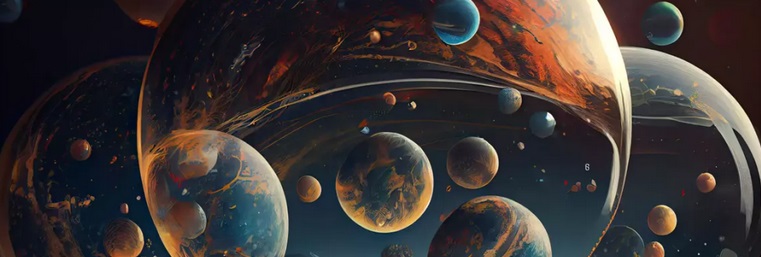
The multiverse concept originated as scientists tried to understand cosmic fine-tuning and the origins of our universe. In simple terms, a multiverse means multiple universes exist instead of just one cosmos. There are different multiverse models in science. For example, cosmological theories of eternal inflation suggest our universe is one “bubble” among countless expanding bubble-universes produced by repeated Big Bang-like events ourdailybread.org. String theory adds another idea: universes could float in higher-dimensional space, spawning new universes when they collide ourdailybread.org. Even quantum physics has a version: the “many-worlds” interpretation where every quantum outcome spawns a new universe ourdailybread.org. All these versions are speculative and currently unproven. As one science writer notes, “All these models of the multiverse are speculative, conjectural, and unproven” ourdailybread.org, meaning the multiverse is a hypothesis beyond direct observation for now.
Despite the lack of direct evidence, many scientists take the multiverse idea seriously because it could explain the fine-tuning of physical laws without invoking a designer. Our universe’s fundamental constants (gravity’s strength, properties of particles, etc.) seem precisely set to allow life. This is puzzling if only chance is at work. One naturalistic explanation is that if vastly many universes exist with varied laws, it’s not surprising that one (ours) turned out to have life-permitting conditions – we just happen to live in the lucky universe. As an analogy, if you have countless lottery tickets, it’s less surprising that one of them wins. Thus, some atheists hail the multiverse as an alternative to a single Creator that purposefully fine-tuned one universe. Indeed, British cosmologist Bernard Carr famously quipped: “If there is only one universe, you might have to have a fine-tuner. If you don’t want God, you’d better have a multiverse.” icr.org. Carr’s point is that a multiverse can be seen as science’s alternative to an “Intelligent Creator” behind cosmic coincidences.
However, what are the implications if a multiverse does exist? First, it would expand our conception of creation enormously – reality would be a vast ensemble of universes, not just our own starry skies. This has deep philosophical and theological implications. It raises new questions: Why does such a multiverse exist? How do we find meaning in a multiverse? But importantly, it does not automatically negate God. Even as a scientific hypothesis, the multiverse touches on metaphysical questions. As we shall see, even a multiverse would need an ultimate explanation. In fact, acknowledging the multiverse idea challenges us to think in broader terms about how God’s creative power might operate on a multicosmic scale. As one science-faith organization puts it: “Even if multiverse theories eventually explain scientifically how our universe began, the multiverse itself would still be God’s creation. Scientific explanations cannot replace God but rather increase our wonder and praise of the Creator God.” biologos.org. In other words, explaining a process scientifically (even a fantastical one like universe-generators) does not eliminate the possibility of a divine Creator – it simply moves the question one step back.
The Case for God in a Multiverse
Why would God’s existence be compatible with, or even supported by, a multiverse? There are several thoughtful reasons:
- Ultimate Causation: A multiverse, if real, still requires an origin or cause beyond itself. The multiverse idea might push the question of origins to a higher level, but it doesn’t answer it. We can ask: “Why does a multiverse (with its laws and potential) exist at all, instead of nothing?” The existence of a vast ensemble of universes still cries out for an explanation. Theists argue that God can serve as the ultimate cause or sufficient reason for not just one universe, but the entire multiverse “super-structure.” In fact, from a religious perspective the multiverse could be seen as part of the creative handiwork of God. The anthropic coincidences that required explanation in one universe still require explanation across the whole multiverse. As one theologian observed, if one universe’s existence points to God, having a multiverse actually compounds the problem for atheism – an infinite array of universes means even more that each one needs an explanation for its existence ourdailybread.org. The presence of multiple universes doesn’t remove the need for a creator; it amplifies it by multiplying the instances of creation that beg for a reason. In short, a multiverse is not self-explanatory – we could still “need a God to explain why the multiverse exists at all” strangenotions.com.
- God’s Omnipotence and Creativity: The multiverse concept can be seen as a natural extension of God’s creative freedom. If God is all-powerful and imaginative, there is no reason to assume He would be limited to making just a single universe. The Bible and classical theology do not insist that God created only one world; they simply describe our universe’s creation. In fact, some theologians through history speculated that an infinite God could create multiple worlds – a notion quite consistent with the multiverse idea. Modern Christian thinkers echo this point. For instance, John Lennox, an Oxford mathematician and Christian apologist, states, “God could create as many universes as He pleases. However, the multiverse concept of itself does not and cannot rule God out.”ourdailybread.org. This highlights that an all-powerful Creator could fashion a multiverse just as easily as a single universe. Such a creation might even magnify the glory of God. If a single cosmos with its grandeur declares God’s glory, how much more an expansive multiverse filled with untold wonders? Rather than contradicting divine creation, a multiverse could be viewed as showcasing God’s limitless creativity, variety, and power on an even grander scale.
- Fine-Tuning Doesn’t Vanish: One motivation for proposing a multiverse was to explain the uncanny fine-tuning of physics for life. But paradoxically, a multiverse may not eliminate the sense of design – it could just relocate it. Any multiverse would operate under higher-level laws or mechanisms that allow multiple universes to form. We can ask whether those meta-laws themselves are “fine-tuned.” For example, the most popular multiverse mechanism involves eternal inflation, which needs just the right conditions to spawn many bubble universes with differing constants. Some physicists have pointed out that inflation (or other universe-generators) might require special settings itselfcrossexamined.orgworldviewofjesus.com. If so, the multiverse theory “finds itself in the same boat” as the single-universe case – it requires an explanation for why this overarching system is just right to produce life-permitting worldsworldviewofjesus.com. In theological terms, one could argue God designed the multiverse itself to have the potential for life. Even atheist physicist Stephen Weinberg conceded, “I don’t think that the multiverse idea destroys the possibility of an intelligent, benevolent creator. What it does is remove one of the arguments for it.”icr.org. Weinberg notes that while a multiverse might address the fine-tuning argument (one argument for God), it does not disprove a creator’s existence – other arguments and the fundamental question of why such a multiverse exists remain. Thus, the door to God is still open in a multiverse.
- Meaning and Moral Order: While scientific multiverse theories focus on physical cosmology, they don’t address questions of meaning, morality, or purpose. The existence of multiple universes filled with stars and galaxies does not answer why there is moral law, consciousness, or love. Those more abstract realities were traditionally in the purview of religion. One could argue that even in a multiverse, humans seeking meaning and moral truth might find that God provides answers that a purely physical theory cannot. A multiverse doesn’t explain the origin of moral values or the intelligibility of reason; those are realms where many feel a Creator’s guidance is still needed. In sum, the spiritual questions remain unchanged by the multiverse hypothesis. If anything, a vast multiverse might deepen the mystery of existence and increase our awe, leading us to consider God’s role with even greater reverence.
In light of these points, the case can be made that a multiverse poses no threat to belief in God. Instead of viewing multiverse and God in opposition, one can view them in harmony: God as the architect behind a multiverse. The multiverse could be God’s mechanism or canvas for creation. This perspective neither denies the scientific curiosity of the multiverse nor the spiritual intuition of a Creator – it embraces a bigger picture that includes both. As one writer elegantly put it, “The God hypothesis and the multiverse hypothesis thus are not incompatible.”
strangenotions.com. A person of faith can accept whatever science eventually discovers about multiple universes, while still seeing the hand of God at work on the grandest scale.
Quotes Supporting the Compatibility
To reinforce the compatibility of God and the multiverse, consider these voices from both science and religion who affirm that a Creator could still lie behind a multiverse:
- John Lennox (Mathematician & Theologian): “God could create as many universes as He pleases. However, the multiverse concept of itself does not and cannot rule God out.” ourdailybread.org – Here Lennox emphasizes that God’s creative power isn’t limited. Even if modern cosmology points to a multitude of worlds, that in no way excludes God’s existence or involvement. The multiverse idea alone, he notes, cannot “rule God out.” It’s a scientific proposal, but one that remains under the sovereignty of a possible Creator.
- Bernard Carr (Cosmologist): “If there is only one universe, you might have to have a fine-tuner. If you don’t want God, you’d better have a multiverse.” icr.org – Carr’s famous statement highlights how strongly the evidence of fine-tuning in physics suggests a “fine-tuner” (i.e. God) unless one posits innumerable other universes to dilute the improbability. Rather than disproving God, this quote ironically shows that the multiverse was invoked precisely to avoid the conclusion of a Creator. It implies that the idea of God naturally arises as an explanation for a single finely-tuned universe; only a multiverse would provide an alternative. And even that alternative, as we have seen, doesn’t escape the need for explanation itself.
- Stephen Weinberg (Physicist, Nobel Laureate): “I don’t think that the multiverse idea destroys the possibility of an intelligent, benevolent creator. What it does is remove one of the arguments for it.” icr.org – Coming from an avowed atheist, this admission is striking. Weinberg acknowledges that even if the multiverse weakens the fine-tuning argument for God, it does not eliminate God’s possibility. There could still be a Creator behind all universes. The multiverse only tries to explain one aspect of why we might infer design; it does not disprove a designer. This quote underscores that a thoughtful scientist sees no logical impossibility of God in a multiverse scenario.
- BioLogos Foundation (Science & Faith Organization): “Even if multiverse theories eventually explain scientifically how our universe began, the multiverse itself would still be God’s creation. Scientific explanations cannot replace God but rather increase our wonder and praise of the Creator God.” biologos.org – This statement, written from a Christian perspective, encapsulates the harmony between the multiverse concept and belief in God. It reminds us that explaining a process (like a multiverse generating universes) doesn’t explain away God; instead, for believers it expands the scope of God’s creation. The more we discover about the cosmos (or cosmoses!), the more awe we have for the Creator. In a sense, an expansive multiverse would make God’s creative work even more majestic, worthy of praise.
These quotes, from a variety of thinkers, all reinforce the central idea: God and the multiverse are not mutually exclusive. In fact, recognizing a multiverse can lead to even deeper admiration for a Creator who could design such a boundless reality. Both scientists (even non-religious ones) and religious scholars find that a multiverse does not nullify the concept of God. On the contrary, it can fit within a theistic worldview and sometimes even underscore it.
Conclusion
In conclusion, the existence of a multiverse – far from disproving God – can be seen as aligned with the possibility of God’s existence. We acknowledged the multiverse as a serious scientific hypothesis that widens our cosmic horizons. Yet, rather than eliminate the need for a Creator, a multiverse still faces profound questions of origin, order, and purpose that naturally lead to theological contemplation. The case for God in a multiverse rests on understanding God as the ultimate ground of all reality, one who could create not just one universe but a limitless ensemble of them. It highlights that God’s creative scope could encompass a multiverse, and that the wonders of multiple universes would only multiply the glory attributed to their Creator.
The idea of God remains logically and philosophically viable in light of a multiverse. Indeed, for those predisposed to belief, a multiverse might illustrate God’s ingenuity on an even grander scale. As one article noted, “if there really is a multiverse, our God is still the Creator of the entire superstructure and He still reigns supreme over it all.” Ultimately, science and faith both seek truth and wonder. The multiverse, should it exist, would be an astonishing scientific truth – and for believers, it would be yet another facet of the wondrous creation that points back to an even more astonishing God.
Sources: The arguments and quotes above draw upon insights from cosmologists, physicists, and theologians who have reflected on God and the multiverse icr.org ourdailybread.org biologos.org. Their consensus is clear: multiple universes do not eliminate the divine. If anything, they expand our conception of what a Creator could create. In the end, whether we live in one universe or a multiverse, the enduring questions of why there is something rather than nothing, why the cosmos is ordered, and where ultimate meaning comes from continue to point many toward God – the eternal reality behind all realities.



 The Glorious Quran and Science
Leave a comment