

To know our website, click on our header menu: Highlights
Written and collected by Zia H Shah MD, Chief Editor of the Muslim Times
Throughout its chapters, the Qur’an repeatedly calls upon its readers to observe the natural world and to reflect on its origins, structure, and purposeful order. In doing so, it offers a compelling cosmological argument for the existence of God—a line of reasoning that begins with the observation that everything that comes into being must have a cause and culminates in the conclusion that an uncaused, necessary Being must be responsible for the creation and sustenance of the universe.
1. The Principle of Causality in Creation
One of the foundational ideas in cosmological arguments is that every finite, created entity must have a cause. The Qur’an emphasizes this notion by urging its readers to question the origins of the cosmos. For example, consider the verse:
“Or were they created by nothing? Or were they the creators of themselves? Or did they create the heavens and the earth? Rather, they are not certain.”
— Qur’an 52:35
This verse challenges any notion that the universe could have emerged without a deliberate cause. By presenting the three possibilities—creation from nothing, self-creation, or creation by something created—and dismissing them as irrational or unconvincing, the Qur’an implicitly guides the reader to the only remaining explanation: the universe must have been brought into existence by an uncreated Creator.
2. Observing Order and Design
The Qur’an repeatedly calls attention to the harmonious order and precise balance inherent in creation. This order is presented as a sign that the universe was not assembled by random chance but was instead designed with deliberate purpose. As the Qur’an declares:
“Indeed, in the creation of the heavens and the earth and the alternation of the night and the day are signs for those of understanding.”
— Qur’an 3:190
Here, the natural cycles and the coordination of celestial bodies are not presented merely as phenomena but as “signs” (āyāt) pointing to an intelligent Designer. When we observe how the sun and the moon follow their appointed courses—“each running its course until an appointed time” (Qur’an 13:2)—we are invited to see that such regularity and precision could not have arisen without a purposeful origin.
3. The Argument from Contingency
The cosmological argument also rests on the idea that everything in the universe is contingent—that is, everything that exists depends on something else for its existence. In contrast, the Necessary Existent (God) must exist by virtue of His own nature, independent of any external cause. The Qur’an reminds us of our own dependence on God:
“Allah, there is no deity except Him, the Ever-Living, the Sustainer of [all] existence.”
— Qur’an 2:255 (Ayat al-Kursi)
This verse (commonly known as Ayat al-Kursi) not only affirms the oneness of God but also highlights His self-sufficiency and absolute authority over all creation. Since everything else is contingent, it follows logically that the origin of the universe—its beginning and continued existence—must rest on an uncaused, necessary Being.
4. The Teleological Evidence: Design in the Cosmos
Beyond causality, the Qur’an appeals to the intricate design of the universe as further evidence for a Creator. The arrangement of the cosmos, with its ordered cycles and balanced systems, strongly suggests intentionality. In one striking example, the Qur’an states:
“He created the heavens and the earth in truth. High is He above what they associate with Him.”
— Qur’an 39:5
This verse asserts that the cosmos is not a chaotic accident; rather, it is the product of deliberate design by a Supreme Being. The teleological argument—one that argues from the apparent purpose and design in the world—finds support in the observation that every aspect of the natural order, from the regularity of celestial motions to the cycle of life on earth, points to a divine lawgiver.
5. The Qur’anic Invitation to Reflect
One of the most unique aspects of the Qur’an is that its cosmological argument is woven into a broader spiritual and moral framework. The text does not merely present a logical proof; it also calls upon the human heart and mind to ponder deeply. As the Qur’an says:
“So have they not traveled through the earth and have hearts by which to reason and ears by which to hear? For indeed, it is not the eyes that are blinded, but blinded are the hearts which are within the breasts.”
— Qur’an 22:46
This invitation to reflection is central to the Qur’anic method. By engaging both the intellect and the intuitive sense of wonder, the Qur’an builds a cumulative case for the existence of God—one that resonates on both rational and experiential levels.
6. The Qur’an’s Self-Referential Miracle
Finally, the Qur’an itself is presented as a miraculous sign—a text that is inimitable and unmatched in its depth, eloquence, and transformative power. The challenge given to those who doubt its divine origin is both a literary and a philosophical one:
“And if you are in doubt about what We have sent down upon Our Servant, then produce a surah the like thereof and call upon your witnesses other than Allah, if you should be truthful.”
— Qur’an 2:23
This challenge, which remains unmet, serves as further proof for believers that the Qur’an is not the product of human invention but a revelation from the Lord of the worlds—a revelation that encapsulates within its verses a comprehensive argument for the existence of God.
Conclusion
Through its vivid descriptions of creation, its logical questioning of the origins of the universe, and its call to both intellectual and spiritual reflection, the Qur’an offers a comprehensive cosmological argument for the existence of God. It guides its readers to understand that the intricate order of the cosmos, the inherent contingency of all that exists, and the undeniable presence of design all point toward a single, uncaused Creator. In this way, the Qur’an stands as not only a book of spiritual guidance but also as a profound invitation to explore the deep connections between faith, reason, and the natural world.



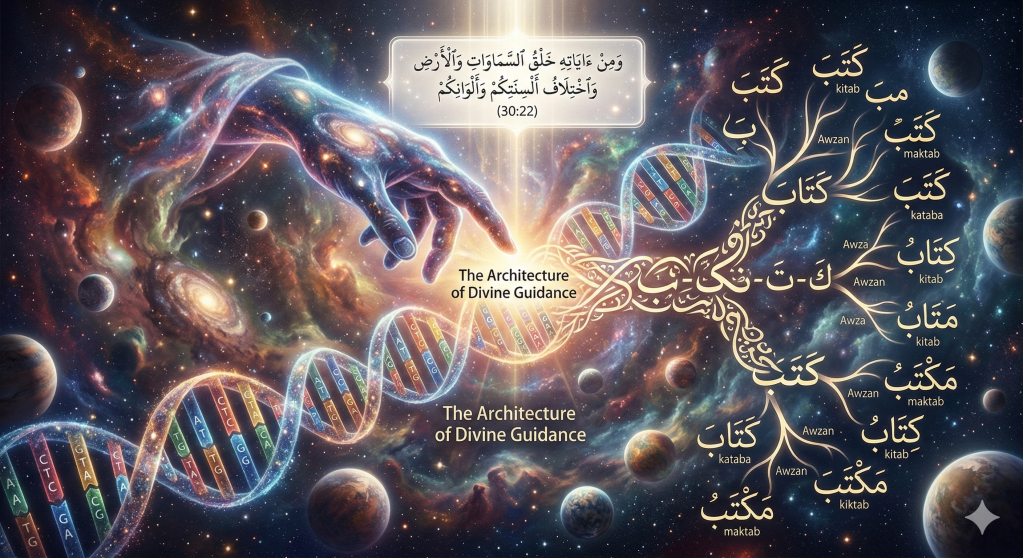
 The Glorious Quran and Science
Leave a comment