

Written and collected by Zia H Shah MD
Introduction
The Quran, Islam’s sacred scripture, is revered as a timeless guide for spiritual, moral, and intellectual enlightenment. While its primary purpose is to convey divine guidance, many verses invite reflection on the natural world, urging believers to observe the cosmos, Earth, and human existence as “signs” (āyāt) of God’s wisdom. To fully appreciate these verses, science serves as a vital interpretive tool, unlocking layers of meaning that resonate with modern discoveries. This article explores why scientific knowledge is essential for interpreting certain Quranic passages, fostering a deeper dialogue between faith and reason.
1. The Quran’s Call to Observe Nature
The Quran repeatedly encourages the study of creation:
“Indeed, in the creation of the heavens and the earth, and the alternation of the night and the day, are signs for those of understanding.” (Quran 3:190).
This mandate to investigate the natural world implies that scientific inquiry is not merely compatible with faith but integral to it. For example:
- Cosmology: Verses describing the universe’s origin (“Then He directed Himself to the heaven while it was smoke…” 41:11) align metaphorically with the Big Bang theory.
- Embryology: Detailed descriptions of human development (“We created man from an extract of clay… Then We made him a drop in a place of settlement…” 23:12–14) mirror modern embryological stages.
Science provides a framework to decode these metaphors, transforming them from abstract imagery into profound insights about divine design.
2. Historical Context and Evolving Knowledge
In the 7th century, the Quran’s audience relied on pre-scientific observations. Descriptions of natural phenomena used language accessible to them, while remaining open to deeper interpretations as human understanding advanced. Classical scholars like Ibn Sina (Avicenna) and Al-Biruni harmonized Quranic teachings with the science of their time, emphasizing observation and reason. Today, modern science offers new lenses to revisit these verses, revealing nuances that earlier exegetes could not access.
Example: The verse “And the heaven We constructed with strength, and indeed, We are [its] expander.” (51:47) now resonates with the discovery of the universe’s expansion, a concept unknown in the medieval era.
3. Science as a Tool for Metaphorical Interpretation
Many Quranic descriptions of nature employ poetic language. Science helps distinguish literal statements from metaphors and contextualizes their significance:
- Water Cycle: “And We send down rain from the sky in measured amounts, and We revive thereby a dead land…” (43:11). Modern hydrology explains the precision of evaporation, cloud formation, and precipitation, enriching this verse’s theological message about divine sustenance.
- Mountain Stabilizers: “And He has cast into the earth firmly set mountains, lest it shift with you…” (31:10). Plate tectonics reveals how mountain roots anchor tectonic plates, validating the metaphor of mountains as “pegs” (awtad).
Without scientific context, such verses risk being reduced to mere allegory or misunderstood as prescientific claims.
4. Addressing Misinterpretations and Avoiding “Scientism”
While science illuminates many Quranic passages, caution is necessary:
- Avoiding Forced Concordance: Not every verse has a scientific “parallel.” For example, attempts to link the “smoke” (41:11) of creation solely to post-Big Bang plasma may overlook the verse’s symbolic emphasis on God’s sovereignty.
- Dynamic Scientific Theories: Scientific models evolve, and rigidly tying Quranic exegesis to transient theories risks future dissonance. The Quran’s descriptions should be seen as compatible with science, not dependent on it.
The goal is not to “prove” the Quran through science but to deepen appreciation of its layered wisdom.
5. Strengthening Faith Through Scientific Insight
For many, scientific discoveries affirm the Quran’s timelessness. The alignment between its verses and phenomena like embryogenesis, cosmic expansion, or ecological balance reinforces the belief in a divine Author who transcends time and human limitation. As physicist Nidhal Guessoum notes, “The Quran speaks to all epochs, using the language of each era.” Science, as the language of our age, becomes a bridge to its message.
6. Conclusion: A Harmonious Pursuit of Truth
The Quran’s engagement with nature invites believers to explore creation with curiosity and humility. Science, far from conflicting with faith, offers tools to unlock deeper dimensions of Quranic wisdom. By embracing both revelation and reason, Muslims can cultivate a holistic worldview—one where the study of quarks and galaxies becomes an act of worship, and the Quran’s verses shine as beacons guiding humanity toward truth in every age.
References
- Guessoum, N. (2011). Islam’s Quantum Question: Reconciling Muslim Tradition and Modern Science.
- Al-Ali, M. (2020). The Quran and Modern Science: A Synthesis of Faith and Reason.
- Quranic translations and exegeses by Abdel Haleem, Yusuf Ali, and Ibn Kathir.
Key Takeaways
- The Quran encourages the study of nature as a means to recognize divine wisdom.
- Science contextualizes metaphorical descriptions of natural phenomena.
- A balanced approach avoids forcing scientific meanings while appreciating synergies.
- Faith and science together foster a richer understanding of the Quran’s message.
In a world often divided between secular and sacred, the Quran reminds us that all knowledge, scientific or spiritual, ultimately points to the same Truth.




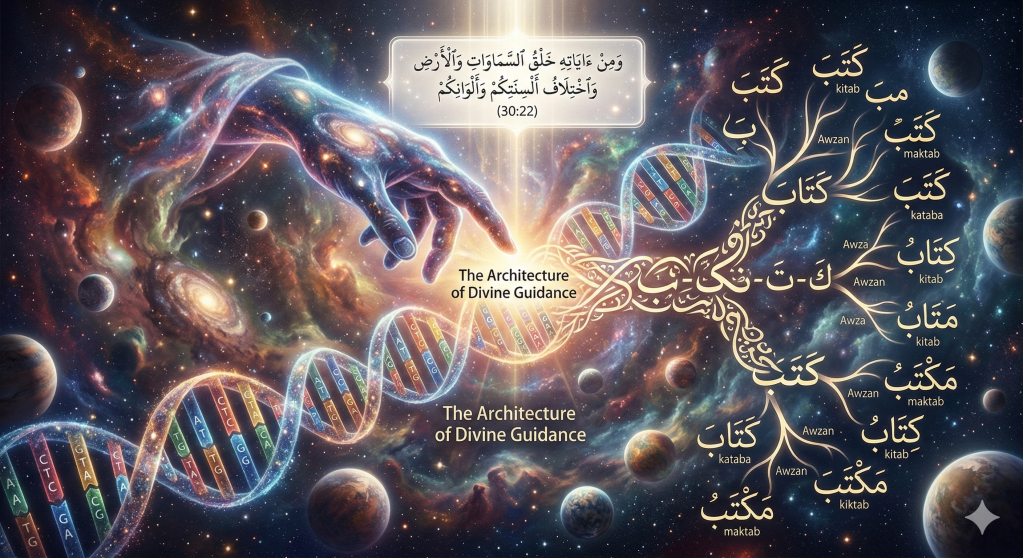
 The Glorious Quran and Science
Leave a comment