
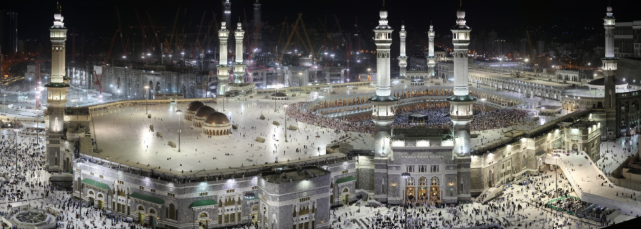
Source: The Study Quran — A Commentary by Seyyed Hossein Nasr and colleagues
Author of the Essay: The Quran and Sufism: William C Chittick
The Arabic word ṣūfī, from which English “Sufism” is derived, was first used to designate a certain type of religiosity in the second/eighth century. The original meaning of the word seems to have been “someone who wears wool,” though other derivations have also been proposed. Once the word came into use, Muslim scholars never reached any consensus as to what exactly it implied. Down into the seventh/thirteenth century, it was generally used to characterize certain saintly figures and their teachings, and from then on it was also applied to various “orders” (lit. “paths,” ṭuruq; sing. ṭarīqah), within which teachers guided students on the quest for God. Many scores of such orders still flourish in the Islamic world, each of them tracing its lineage back to one or more founding saints and eventually to the Prophet. For centuries, the orders played a dominant role in the religious life of the Muslim community, but more recently the politicized forms of Islam known as “fundamentalism” have to a notable degree obscured their presence, at least to the media.
Modern-day scholars commonly take the word “Sufism” as a synonym for mysticism, spirituality, or esoterism, all of which suggest something of what the word has connoted. For the purposes of this essay, Sufism can best be understood in relation to the structure of the Islamic tradition. The twin foundations of Islam—the Quran and the Sunnah—provide guidance on three levels: activity, understanding, and transformation; or practice, thought, and spirituality. As Muslims drew out the implications of God’s Guidance on the level of practice and activity, they gradually brought into being the realm of jurisprudence (fiqh) and the schools of the Revealed Law (the madhāhib of the Sharīʿah). As they pondered the implications of Divine Guidance for a correct understanding of God, the cosmos “everything other than God”), and human embodiment, they gave rise to schools of thought like kalām (theology) and philosophy. At the same time, many Muslims—often the same figures involved in the first two realms—held that the goal of both right activity and correct understanding was transformation of the soul, that is, achieving inner conformity with al-Ḥaqq, “the Real,” the Supreme Truth and Absolute Reality that is God Himself. It is these Muslims who were often called “Sufis” by their contemporaries or by later generations.
The outstanding characteristic of the Sufi approach to the Islamic tradition has been to focus on assimilating the soul to the Divine Word, always on the basis of the model established by the Prophet. Addressing him, the Quran says, Truly thou art of an exalted (ʿaẓīm) character (68:4), and it was lost on no one that the Quran uses the same adjective to refer to itself—the Mighty (ʿaẓīm) Quran (15:87). The exaltedness of the Prophet’s character derives precisely from the fact that he had assimilated the Quran into his very being. This is how Sufis have understood the saying of the Prophet’s wife ʿĀʾishah, when she was asked about his character after his death. She replied, “Have you not read the Quran? His character was the Quran.”
The Quran’s role in the soul’s transformation is implicit in the accounts of the Prophet’s ascent (miʿrāj) to God, the “Night Journey,” to which reference is made in 17:1: Glory be to Him Who carried His servant by night. Laylat al-isrāʾ, “the Night of the Journey,” or al-miʿrāj, “the Ascent,” was understood as the fulfillment of laylat al-qadr, “the Night of Power” (97:1–3). Having brought the Divine Word down to the Prophet on the Night of Power, Gabriel took him up to meet God on the Night of the Journey. He could encounter God precisely because “His character was the Quran,” which had descended into his soul and transmuted it into a luminous lamp (33:46) in answer to his prayer, “Make me into a light.”2 The Quran itself, after all, is the light (64:8), revealed by the Light of the heavens and the earth (24:35) to bring forth mankind out of darkness into light (14:1).
…
The most salient part of the essay is under the last heading ‘Love.’ For that you have to find the essay below. Go to the PDF file included here and find the essay in the table of contents:

 The Glorious Quran and Science
Leave a comment