
Epigraph:
The Messiah, son of Mary, was only a Messenger; surely, Messengers like unto him had indeed passed away before him. And his mother was a truthful woman. They both used to eat food. See how We explain the Signs for their good, and see how they are turned away. (Al Quran 5:75)
Written and collected by Zia H Shah MD, Chief Editor of the Muslim Times
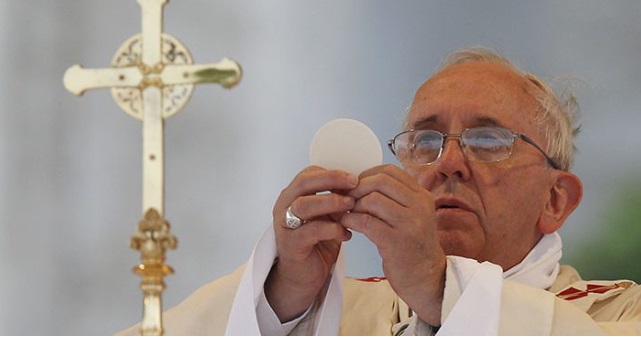
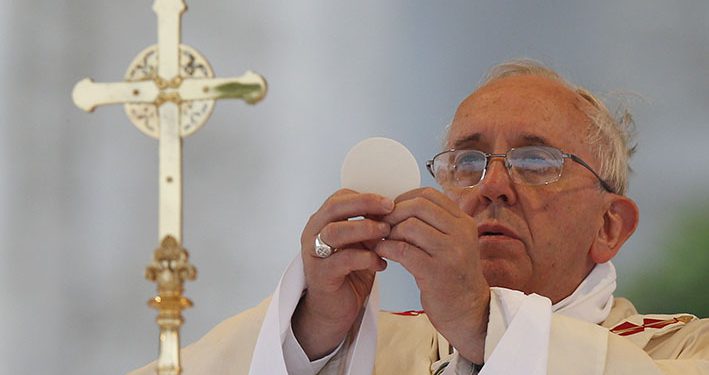
The Eucharist, also known as Holy Communion or the Lord’s Supper, is a central rite in Christianity, commemorating Jesus Christ’s Last Supper with his disciples. While its observance is widespread among Christian denominations, interpretations of its significance and the nature of Christ’s presence in the elements vary.
Roman Catholicism
In Roman Catholic theology, the Eucharist is believed to be the actual body and blood of Christ under the appearances of bread and wine. This change is termed “transubstantiation,” indicating that the substance of bread and wine becomes the body and blood of Christ, while their accidents (sensory characteristics) remain unchanged. The Catechism of the Catholic Church states, “By the consecration, the transubstantiation of the bread and wine into the Body and Blood of Christ is brought about.”
Eastern Orthodoxy and Oriental Orthodoxy
Eastern Orthodox and Oriental Orthodox Churches also affirm the real presence of Christ in the Eucharist. While they may not use the term “transubstantiation” explicitly, they uphold that the bread and wine become the actual body and blood of Christ through the Holy Spirit’s action during the Divine Liturgy. This transformation is considered a sacred mystery, beyond human comprehension.
Lutheranism
Lutherans believe in the real presence of Christ in the Eucharist, teaching that the body and blood of Christ are truly present “in, with, and under” the forms of bread and wine—a concept known as “sacramental union.” They reject the term “transubstantiation,” emphasizing instead that Christ’s words, “This is my body,” are taken at face value. The Lutheran Confessions state, “The bread and wine in the Supper are the true body and blood of Christ.”
Anglicanism
Anglican beliefs regarding the Eucharist encompass a spectrum, reflecting the tradition’s broad churchmanship. The Thirty-Nine Articles of Religion, foundational to Anglican doctrine, state that “The Body of Christ is given, taken, and eaten, in the Supper, only after an heavenly and spiritual manner.” This allows for interpretations ranging from a spiritual presence to views closely aligned with transubstantiation, depending on the particular Anglican community.
Reformed Traditions
Reformed churches, including Presbyterians and Congregationalists, generally hold to a “pneumatic” or spiritual presence of Christ in the Eucharist. They teach that through the Holy Spirit and received by faith, believers partake in the body and blood of Christ in a spiritual sense. John Calvin articulated this view, emphasizing the believer’s communion with Christ during the Lord’s Supper.
Methodism
Methodists affirm the real presence of Christ in the Eucharist but describe it as a “Holy Mystery.” They avoid defining the specific mechanics of this presence, focusing instead on the transformative grace imparted through the sacrament. The United Methodist Church’s Book of Discipline states, “The Lord’s Supper is a representation of our redemption, a memorial of the sufferings and death of Christ, and a token of love and union which Christians have with Christ and with one another.”
Baptists and Anabaptists
Many Baptist and Anabaptist traditions view the Eucharist as an ordinance—a symbolic act of obedience—rather than a sacrament imparting grace. They practice “memorialism,” holding that the bread and wine (or grape juice) are symbolic representations of Christ’s body and blood, serving as reminders of his sacrifice. The Southern Baptist Convention, for example, describes the Lord’s Supper as “a symbolic act of obedience whereby members… memorialize the death of the Redeemer and anticipate His second coming.”
Quakers (Religious Society of Friends)
Quakers do not observe outward sacraments, including the Eucharist, believing that all of life is sacramental. They emphasize an inward, spiritual communion with Christ, holding that external rituals are unnecessary for experiencing God’s presence. As stated by the Friends General Conference, “We believe in the baptism of the Holy Spirit and in communion with that Spirit. If the believer experiences such spiritual baptism and communion, then no rite or ritual is necessary.”
While the Eucharist is a unifying practice among Christians, its theological interpretations and liturgical expressions vary significantly across denominations, reflecting diverse understandings of Christ’s presence and the sacrament’s role in the life of the church.
The Catholic doctrine of transubstantiation posits that during the consecration in the Mass, the substances of bread and wine are transformed into the actual body and blood of Christ, while their appearances (or “accidents”) remain unchanged. This belief hinges on a distinction between ‘substance’ and ‘accidents’ rooted in Aristotelian philosophy.
From a scientific perspective, this doctrine presents challenges. Empirical methods rely on observable and measurable phenomena. Since the consecrated elements retain all observable properties of bread and wine, including chemical composition and physical characteristics, science cannot detect any change in their fundamental nature. As noted in an article from the Church Life Journal, “scientific experiments cannot falsify the doctrine of transubstantiation, because the doctrine itself asserts that the bread and wine after consecration remain on the empirical level the same as before.” churchlifejournal.nd.edu
Furthermore, the concept of a substance existing independently of its observable properties is not recognized in modern scientific discourse. Science understands substances through their measurable properties; a change in substance without a corresponding change in observable properties is inconsistent with empirical methodologies.
Eucharistic miracles, where consecrated hosts are reported to exhibit physical transformations into human tissue or blood, are often cited as evidence supporting transubstantiation. However, these claims are met with skepticism in the scientific community. Investigations have sometimes revealed natural explanations, such as contamination by microorganisms. A study published in the Journal of Forensic Science and Research demonstrated that unconsecrated wafers could develop reddish appearances under certain conditions, which were not due to miraculous causes but to natural processes. Forensic Science International
Atheists, who do not subscribe to religious beliefs, generally view the Eucharist as a ritual rooted in religious tradition without empirical basis. From a secular perspective, the Eucharist is seen as a symbolic act with historical and cultural significance within Christianity, but lacking supernatural elements.
Some atheists critique the concept of transubstantiation—the belief that bread and wine become the actual body and blood of Christ—as conflicting with scientific understanding. They argue that, since the consecrated elements retain their original physical properties, there is no empirical evidence to support a literal transformation.
Discussions among atheists often address claims of Eucharistic miracles, where the consecrated elements are said to exhibit supernatural phenomena. Skeptics typically attribute these reports to natural explanations, psychological factors, or, in some cases, deliberate fabrication. For instance, in online forums, atheists have expressed skepticism toward such miracles, emphasizing the need for verifiable evidence and suggesting that extraordinary claims require extraordinary proof. Reddit
The question of whether atheists should participate in the Eucharist has also been a topic of discussion. Some argue that partaking in a ritual without belief in its underlying tenets may lack integrity, while others view open communion as a gesture of inclusivity. An article on Patheos presents an atheist’s perspective, suggesting that participating in the Eucharist without belief could be seen as disingenuous and that such rituals hold no personal significance for non-believers. Patheos
Conclusion
In summary, atheists generally regard the Eucharist as a meaningful tradition for believers but view its theological claims through a lens of skepticism, emphasizing the importance of evidence and rational inquiry.
Even though I am a devout theist on the Eucharist, I agree entirely with them. This is one of the reasons why I also think that if there is a constant friendly discussion between the atheists, the Christians, and the Muslims, the only thing that will survive is the rational understanding of Islam.




 The Glorious Quran and Science
Leave a comment