
Epigraph:
Say to them, O Prophet: “Bring forth your proof if you are truthful in and convinced of your claim!” (Al Quran 2:111)
Christianity is the strangest religion ever set up, for it committed a murder upon Jesus in order to redeem mankind from the sin of eating an apple. Thomas Paine
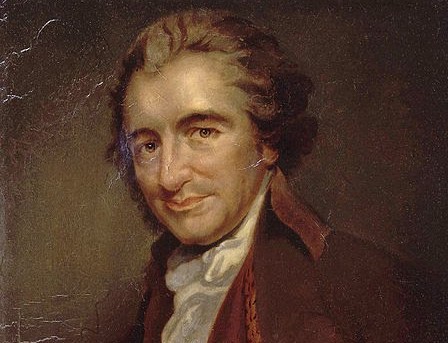
Written and collected by Zia H Shah MD, Chief Editor of the Muslim Times
Thomas Paine’s The Age of Reason, published in three parts between 1794 and 1807, presents a comprehensive critique of organized religion and advocates for deism—the belief in a rational God discernible through nature and reason, rather than through revelation or institutionalized doctrines. Paine’s arguments against organized religion can be summarized as follows:
A. Critique of Religious Institutions
Paine contends that organized religions are human inventions designed to control and manipulate people. He asserts that religious institutions, whether Jewish, Christian, or Muslim, have been established to “terrify and enslave mankind, and monopolize power and profit.”
B. Rejection of Revealed Religion
Paine challenges the legitimacy of revelations, arguing that they are hearsay to anyone other than the person who claims to have received them. He maintains that since these revelations are not universally accessible, they cannot serve as a foundation for a universal religion.
C. Examination of Biblical Inconsistencies
Paine meticulously analyzes the Bible, highlighting contradictions and moral issues within its narratives. He questions the authenticity and divine inspiration of the scriptures, suggesting that they are the work of fallible humans rather than a perfect deity.
D. Advocacy for Deism and Rational Religion
Paine promotes deism, emphasizing that true knowledge of God comes from observing the natural world and applying reason. He argues that the study of nature, rather than scripture, reveals the Creator’s attributes, leading to a purer form of worship free from superstition and dogma.
E. Condemnation of Religious Persecution and Intolerance
Paine criticizes the history of violence and oppression associated with organized religion, including wars, inquisitions, and persecutions carried out in God’s name. He contends that such actions are antithetical to the moral teachings that religions profess to uphold.
F. Emphasis on Personal Morality and Reason
Paine asserts that morality should be grounded in reason and the well-being of humanity, rather than in religious doctrines. He encourages individuals to use their rational faculties to discern right from wrong, independent of clerical authority.
His seminal work critiques organized religion and advocates for deism—the belief in a rational God discernible through nature and reason. The text is renowned for its incisive commentary, with several passages frequently quoted for their profound insights and rhetorical strength:
1. Critique of Religious Institutions
Paine challenges the authority and intentions of organized religions, suggesting they are human constructs designed to control and profit:
“All national institutions of churches, whether Jewish, Christian, or Turkish, appear to me no other than human inventions set up to terrify and enslave mankind, and monopolize power and profit.”
2. Emphasis on Personal Reason and Belief
He advocates for individual thought and personal belief systems, free from institutional dogma:
“My own mind is my own church.”
3. Criticism of Biblical Morality
Paine critiques the moral narratives within religious texts, particularly the Bible:
“It is from the Bible that man has learned cruelty, rapine, and murder; for the belief of a cruel God makes a cruel man.”
4. Advocacy for Rational Inquiry
He underscores the importance of reason and critical thinking over blind faith:
“It is error only, and not truth, that shrinks from inquiry.”
5. Rejection of Second-Hand Revelation
Paine questions the validity of revelations that are not personally experienced:
“It is a contradiction in terms and ideas, to call anything a revelation that comes to us at second-hand, either verbally or in writing.”
6. Critique of Miracles
He expresses skepticism towards miraculous accounts, favoring natural explanations:
“Is it more probable that nature should go out of her course or that a man should tell a lie? We have never seen, in our time, nature go out of her course. But we have good reason to believe that millions of lies have been told in the same time.”
7. Condemnation of Religious Persecution
Paine condemns the historical use of religion to justify persecution and violence:
“Persecution is not an original feature in any religion; but it is always the strongly marked feature of all religions established by law.”
These passages encapsulate Paine’s arguments for a faith grounded in reason and personal reflection, challenging the established religious orthodoxy of his time. The Age of Reason continues to be a pivotal reference in discussions on religious critique and the advocacy of deism.
Through his arguments, Paine seeks to dismantle the authority of organized religion, advocating for a faith based on reason, personal reflection, and the observable world. His work remains a seminal critique of religious institutions and a foundational text in the philosophy of deism.



 The Glorious Quran and Science
Leave a comment