
Epigraph:
Glory be to Allah! He is far higher than what they ascribe to Him, the Creator of the heavens and earth! How could He have children when He has no spouse, when He created all things, and has full knowledge of all things? This is God, your Lord, there is no God but Him, the Creator of all things, so worship Him; He is in charge of everything. Eyes cannot reach Him, but He reaches human’s consciousness. He is the All Subtle, the All Aware. (Al Quran 6:100-103)
Written and collected by Zia H Shah MD, Chief Editor of the Muslim Times
Human reproduction is a complex process involving the union of genetic material from both the mother and the father, resulting in the conception of a new individual. This process ensures genetic diversity and the continuation of human life.
Gamete Production
In human reproduction, each parent contributes genetic material through specialized reproductive cells known as gametes. The male gamete, or sperm, is produced in the testes, while the female gamete, or egg (ovum), is produced in the ovaries. Each gamete contains 23 chromosomes, half the number found in typical human cells, which have 46 chromosomes arranged in 23 pairs.
Fertilization
Fertilization occurs when a sperm cell successfully merges with an egg cell, forming a zygote. This union restores the chromosome number to 46, with 23 chromosomes inherited from each parent. The combination of genetic material from both parents results in a unique genetic blueprint for the offspring.
Genetic Contribution
Each parent contributes equally to the genetic makeup of their child. However, certain genetic components are inherited exclusively from one parent. For instance, mitochondrial DNA, which plays a crucial role in energy production within cells, is inherited solely from the mother. Conversely, the father determines the sex of the child through the sperm, which can carry either an X or a Y chromosome. An X chromosome results in a female (XX) offspring, while a Y chromosome results in a male (XY) offspring.
Embryonic Development
Following fertilization, the zygote undergoes multiple cell divisions and begins the process of differentiation, eventually developing into an embryo. The genetic information inherited from both parents guides this development, influencing traits such as eye color, blood type, and susceptibility to certain diseases.
Summary of biological process
The biological contributions of both mother and father are essential in human reproduction, each providing half of the genetic material necessary for the creation of a new individual. This intricate process not only ensures the propagation of the species but also contributes to the genetic diversity observed within the human population.
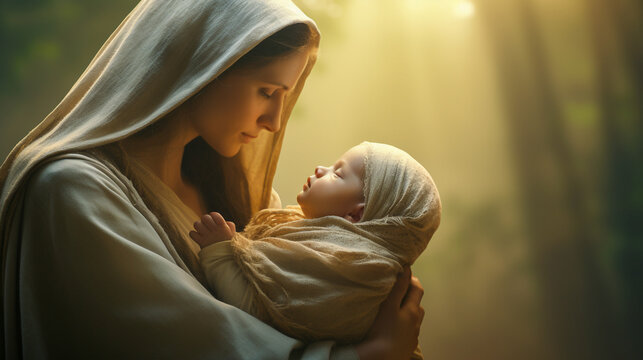
Council of Ephesus in 431 AD labelled mother Mary as God Bearer
The title “Theotokos,” meaning “God-bearer” or “Mother of God,” is a central designation for Mary in Christian theology, emphasizing her role in the Incarnation of Jesus Christ. This title underscores the belief that Mary, through divine intervention, conceived and bore Jesus, who is both fully divine and fully human.
The Virgin Birth and Divine Conception
According to the Gospel of Luke, the angel Gabriel announced to Mary that she would conceive a child by the power of the Holy Spirit, despite being a virgin:
“The Holy Spirit will come upon you, and the power of the Most High will overshadow you; therefore the child to be born will be called holy—the Son of God.”
This miraculous conception signifies that Jesus’ birth was a divine act, with Mary serving as the human vessel through whom God entered the world.
Mary’s Biological Role
While the conception was divine, Mary contributed biologically to Jesus’ human nature. As his mother, she provided the genetic material necessary for his development as a human being. This union of divine and human natures in Jesus is central to the doctrine of the Incarnation, affirming that Jesus is both fully God and fully man.
The Significance of “Theotokos”
The term “Theotokos” was officially affirmed at the Council of Ephesus in 431 AD to emphasize the unity of Christ’s divine and human natures. By calling Mary the “God-bearer,” the Church acknowledged that the child she bore was indeed God incarnate. This title safeguards the doctrine of the Incarnation against heresies that sought to separate or diminish either Christ’s divinity or humanity.
Parthenogenesis as a possible mechanism for virgin birth
Parthenogenesis, commonly known as “virgin birth,” is a form of asexual reproduction where an embryo develops from an unfertilized egg. This phenomenon is observed in various animal species, including certain insects, reptiles, and fish. However, in mammals, including humans, natural parthenogenesis does not occur due to complex genetic and epigenetic factors.
Parthenogenesis in Mammals
Mammals require genetic contributions from both a male and a female parent for successful reproduction. This necessity arises from a process called genomic imprinting, where certain genes are expressed in a parent-of-origin-specific manner. In mammals, imprinting ensures that some genes are active only when inherited from the mother, while others are active only when inherited from the father. This balance is crucial for normal development, making parthenogenesis naturally unfeasible in mammals.
Scientific Advances in Inducing Parthenogenesis
Despite the natural barriers, scientific advancements have enabled the induction of parthenogenesis in mammals under experimental conditions. In 2004, researchers in Japan successfully created a mouse named Kaguya using genetic material from two female mice, effectively bypassing the need for male genetic contribution. This achievement involved complex genetic manipulations to mimic the effects of paternal imprinting, allowing the embryo to develop to term.
More recently, in 2022, scientists reported the birth of mice derived from unfertilized eggs through targeted epigenetic modifications. By altering specific imprinting control regions, they were able to initiate embryonic development without fertilization. While these experiments demonstrate the potential for inducing parthenogenesis in mammals, they are confined to controlled laboratory settings and are not naturally occurring processes.
Parthenogenesis in Humans
In humans, natural parthenogenesis is biologically implausible due to the complexities of genomic imprinting and the necessity for biparental genetic contributions. While there have been anecdotal reports of virgin births among humans, such claims lack scientific verification and are often attributed to factors like misreporting or misunderstandings. A study published in the British Medical Journal in 2013 reported instances of self-identified virgin pregnancies; however, these accounts were based on self-reported data and did not provide biological evidence supporting the occurrence of parthenogenesis in humans.
Conclusion
Mary’s role as the “Theotokos” highlights her unique position in salvation history as the mother of Jesus Christ, who is both God and man, according to the main stream Christian doctrine. Through her willing participation and biological contribution, she became the vessel through which the divine entered into human existence, fulfilling the prophecy of the virgin birth and embodying the union of humanity and divinity in the person of Jesus, as claimed by Catholic, Orthodox and Protestant Christians.
However, the idea of Mary being God bearer is not biologically or scientifically coherent. Even if the birth was virgin Jesus needed 46 chromosomes, 23 from mother Mary and other 23 from another source, possibly mother Mary again in some miraculous fashion and I am exploring parthenogenesis as a hypothesis for now.
Nevertheless, one thing is certain that humans have zero comprehension as to what genetics mean about the make up of transcendent God, who is beyond time, space and matter. Abrahamic faiths only know Him as a spiritual being.
Additional reading:



 The Glorious Quran and Science
Leave a comment