
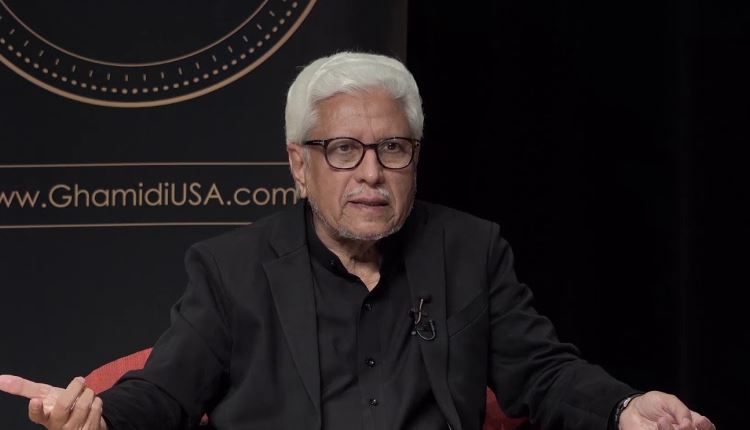
Written and collected by Zia H Shah MD, Chief Editor of the Muslim Times
Firstly my apologies, this article can make sense only if you understand Urdu to appreciate the above six minute video of Javed Ahmed Ghamidi, a popular Muslim scholar from Pakistan.
If the Quran is the literal word of All Knowing God and key to our success in worldly life and Afterlife then how to understand it is the billion dollar question.
The 1.8 billion Muslims have been trying to do exactly that directly personally or through the choice of their scholars or leaders.
I am a fan of Ghamidi but you could think of my relationship with him as ambivalent. I often applaud him and sometimes I critique him. So, what am I doing? My critique is also in a way a compliment in disguise. Ghamidi leaves that opportunity open but the same cannot be said for many other scholars as a peaceful or reasonable response to academic criticism cannot be guaranteed from them.
So, thanks to humility of Ghamidi that it opens the possibility of open and free discussion in interest of better understanding of the Quran.
I agree with many of the statements and observations Ghamidi has made in the above video. Firstly, I agree with him that the Quranic narrative is coherent and continuous and not disjointed and when it appears otherwise, it is due to our lack of understanding the Quran or due to us taking something literally, when it was to be metaphorical or putting some verses in the context of the seventh century Arabia and the neighboring verses in the context of the 21st century Western world.
I applaud his example of pearls being obtained from both freshwater and sea water. First, let us review the verses and the context that he is talking about:
He created mankind out of dried clay, like pottery, the jinn out of smokeless fire. Which, then, of your Lord’s blessings do you both deny? He is Lord of the two risings and Lord of the two settings. Which, then, of your Lord’s blessings do you both deny?
He released the two bodies of [fresh and salt] water. They meet, yet there is a barrier between them they do not cross. Which, then, of your Lord’s blessings do you both deny?
Pearls come forth from them: large ones, and small, brilliant ones. Which, then, of your Lord’s blessings do you both deny? (Al Quran 55:14-23)
His narration about these verses not only establishes the primacy of the Quran in his thinking and of his teacher Amin Ahsan Islahi, but can also serve as an example that without the secular knowledge of freshwater pearls that Ghamidi had but Amin Ahsan Islahi did not, he would not have arrived at correct understanding of these verses.
Now let us embark on a different interpretation of these very verses which arise from a different piece of secular knowledge and it is applied to the construction of Suez and Panama canals to join different oceans. So, now a slightly different translation of the above verses:
He created mankind out of dried clay, like pottery, the jinn out of smokeless fire. Which, then, of your Lord’s blessings do you both deny? The Lord of the two Easts and the Lord of the two Wests! Which, then, of your Lord’s blessings do you both deny?
He has made the two bodies of water flow. They will one day meet. Between them is now a barrier; they encroach not one upon the other. Which, then, of your Lord’s blessings do you both deny?
Pearls come forth from them: large ones, and small, brilliant ones. Which, then, of your Lord’s blessings do you both deny? (Al Quran 55:14-23)
Indeed multiple true translations of the Quran are possible.
Often the commentators of the Quran emphasize that they are understanding the Quran only based on the Quran, Sunnah or Hadith and not their own thinking. This I believe is childish and sometimes seems necessary to keep the conservative Muslim happy so they do not go on a blasphemy mongering rampage. Ghamidi emphasizes in this short video also that he is not being directed by his own thoughts, wisdom or will. One can simply question such views by asking how does a person know that a certain Quranic verse or a certain Hadith are suitable for commentary of a given verse, obviously he or she decides based on his or her own wisdom. So one can simply not exclude ones thoughts by invoking other sources.
For those whose mother tongue is not Arabic it is only through their own thinking that they assign particular meanings to the Arabic words to understand the Quran.
Proofs of everything can be described into two broad categories. Argument from authority or argument from reason. So, commenting on the Quran by quoting other verses, Hadith or past respected commentators will be a form of argument from authority. All other proofs of any commentary that one writes come from facts of different kind, reason, logic, history, archeology, psychology, hard sciences and so on and so forth
So rather than make belief claims of ones righteousness or sacredness of one’s sources of commentary, a more precise way of understanding the Quran properly is to try to ensure that it does not contradict itself or contradict demonstrable facts. For example, if someone wants to claim that moon light is brighter than sunlight based on his understanding of some verse, it simply cannot be granted. Likewise, it cannot be granted that at certain time in human history the moon literally split into two pieces that merged with each other later as that would have led to dramatic consequences on our planet earth that could not have been missed by historians. Such a catastrophe could have possibly made the human race go extinct making all such discussion mute.
Many Muslim scholars and commentators present modern science and its mention in the Quran, which predated those discoveries by many centuries, as proof of the Divine origin or truth of the holy Quran. By the same token, the Quran cannot be explained in contradiction to an absolutely established fact of science as the All-Knowing God would know that. For example, I believe that all life forms on our planet earth have a common ancestry and this has a bearing on all the Quranic verses about the prophet Adam that many established commentators including Ghamidi are not ready to tackle. This is my main question to him today in regard to his commentary of the Quran and I suggest the following additional reading:
The Story of Adam and A Progressive, Metaphorical Reading of the Quran
Surah Al Baqara (The Cow): Section 4: Adam and Eve
Charles Darwin: An Epiphany for the Muslims, A Catastrophe for the Christians
After Monotheism, the Two Most Seminal Verses of the Quran



 The Glorious Quran and Science
Leave a comment